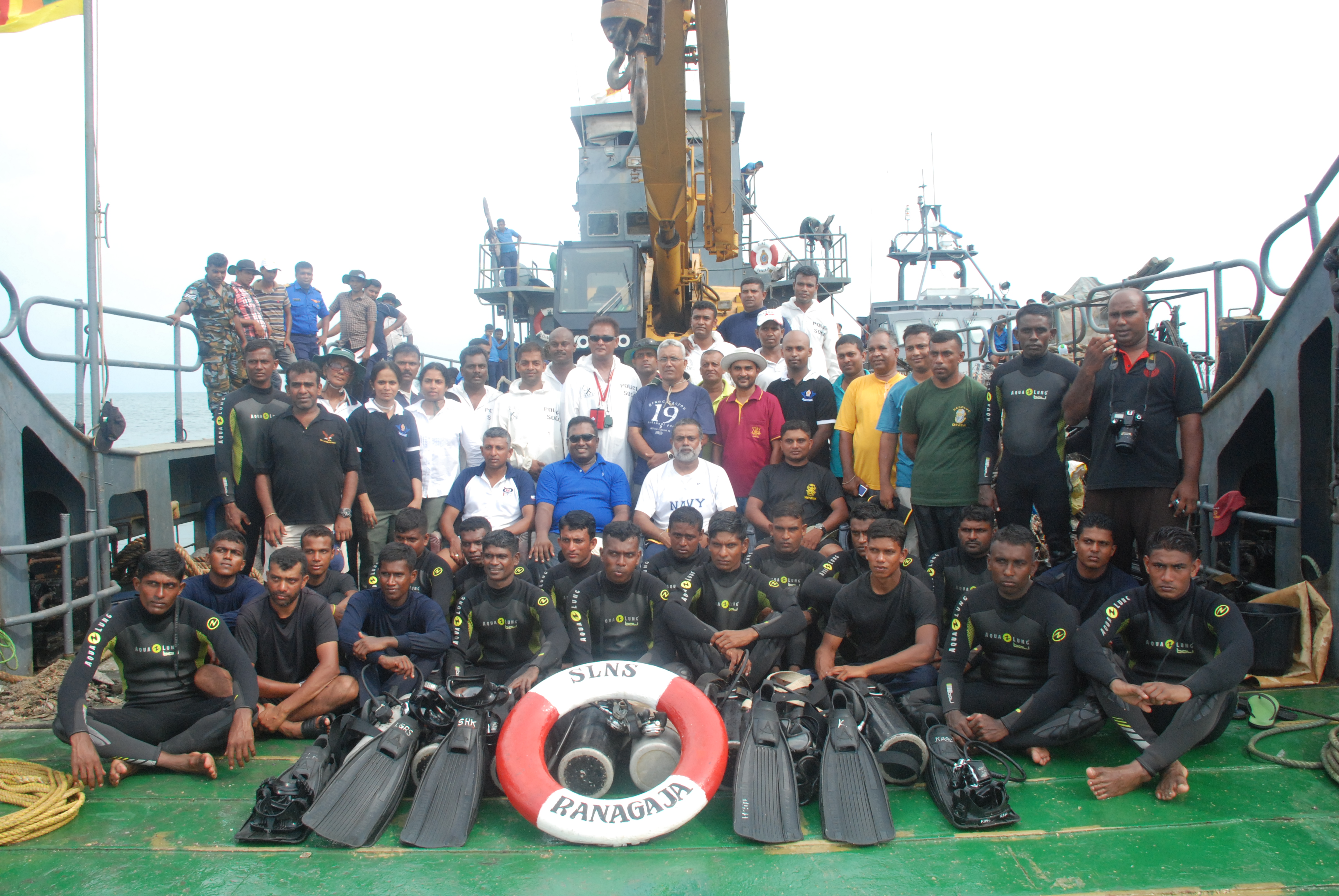
The Sri Lanka Navy (SLN) marked a historic milestone during the salvage of Lionair Flight LN 602, an Antonov An-24RV aircraft, shot down on September 29, 1998. This mission not only showcased the Navy's technological ingenuity and operational excellence but also demonstrated its ability to execute a court-mandated operation with precision and collaboration.
Background of the Incident
Lionair Flight LN 602, carrying 48 passengers and seven crew members, disappeared from radar ten minutes after taking off from Jaffna Airport en route to Colombo. Subsequent investigations confirmed that the aircraft was downed by a missile attack orchestrated by the Liberation Tigers of Tamil Eelam (LTTE). The wreckage remained submerged for nearly 15 years before the Mannar High Court issued an order for its recovery to aid ongoing investigations.
Salvage Mission: Innovation and Execution
In May 2013, under the leadership of Vice Admiral Jayanath Colombage and Rear Admiral Sisira Jayakody, the Sri Lanka Navy began the challenging task of recovering the wreckage. To meet the operational demands, the Navy employed a Landing Craft Mechanized (LCM) as a floating crane barge by mounting a mobile crane onboard. This innovative adaptation marked a first in the Navy’s history and played a crucial role in the salvage efforts.
A dedicated team of 80 divers, led by Captain Jayantha Gamage and Commander Athukorala, worked under challenging conditions to retrieve major components of the aircraft, including the engines, landing gear, and fuselage. The Civil Aviation Authority of Sri Lanka (CAASL) was actively involved, assisting in the identification of recovered parts to confirm their origin as the ill-fated Lionair aircraft.
Operational Challenges and Achievements
The operation faced numerous challenges stemming from the 15-year delay between the incident and the salvage. Prolonged submersion in seawater had caused extensive corrosion and disintegration, complicating the identification and handling of wreckage. Adverse weather conditions, including rough seas and strong underwater currents, further tested the divers' endurance and precision. Additionally, lifting and securing fragile components with the adapted LCM required meticulous coordination and technical skill. Despite these obstacles, the Navy successfully recovered key evidence, including structural parts, engines, and personal belongings. The involvement of CAASL enabled confirmation that the wreckage was indeed from Lionair Flight LN 602. Human remains of 22 victims were also retrieved and displayed for identification, bringing closure to families and aiding the broader investigation.
Significance of the Operation
The salvage mission epitomized the Sri Lanka Navy's capacity to innovate and adapt in the face of adversity. The use of an LCM as a floating crane, coupled with seamless inter-agency
coordination, highlighted the Navy’s technical expertise and commitment to fulfilling its duties under judicial orders.
The recovery of Lionair Flight LN 602's wreckage not only contributed to the investigation of a tragic incident but also showcased the SLN's dedication to upholding justice, providing closure to victims' families, and enhancing its operational legacy. As the Navy celebrates its 60th anniversary, this operation stands as a testament to its resilience, competence, and collaborative spirit.